
 CALL AN EXPERT! +86-131-3073-8426


FFU for HVAC Systems: How Fan Filter Units Complement Central Air Handling
Many facility managers view central HVAC and fan filter units as competing technologies. In reality, these two systems solve different problems—and the most efficient cleanrooms use both strategically. After designing and commissioning hundreds of controlled environments, we consistently find that pairing FFU HVAC architecture delivers superior cleanliness, lower energy costs, and greater operational flexibility than either system alone. Here is how smart integration works.
Table of Contents
ToggleHow Traditional HVAC Supports the Cleanroom Macro-Environment
A central air handling unit (AHU) manages temperature, humidity, and pressurization across the entire facility. It draws outside air, conditions it, and distributes it through ductwork. Without this backbone, no cleanroom can maintain stable environmental parameters.
However, a central AHU faces practical limits. Pushing HEPA-filtered air through long duct runs creates high static pressure, increases energy consumption, and complicates balancing. Adding more terminal outlets means more ductwork, more fire dampers, and more sheet-metal labor. This is exactly where the fan filter unit for clean room applications steps in.

Where the Fan Filter Unit Cleanroom Gap Exists — And How FFUs Fill It
A fan filter unit cleanroom configuration places individual motorized HEPA or ULPA modules directly in the ceiling grid. Each FFU draws air from a shared plenum above the ceiling and pushes it downward through its own filter, creating localized unidirectional airflow right where the process needs it.
This approach offers distinct advantages:
- Point-of-use filtration.Each FFU delivers clean air at the workstation level, eliminating long duct runs and reducing particle migration between zones.
- You can add or remove units as production layouts change without redesigning ductwork.
- If one FFU fails, neighboring units continue operating, preventing total airflow loss in a critical zone.
The central AHU handles temperature and humidity conditioning, while FFUs handle the final-stage filtration and airflow volume. Together, they form a true FFU HVAC partnership.

Architectural Integration: FFUs Within HVAC Ceiling Plenums
Successful hybrid designs treat the space above the ceiling as a pressurized supply plenum. The central AHU delivers conditioned, pre-filtered air into this plenum at a controlled pressure. Each FFU then draws from the plenum independently, filters the air through H13 or H14 media, and delivers it into the room below.
This architecture eliminates individual supply ducts to each ceiling module, dramatically cutting installation cost and construction time. Designers simply specify plenum height, structural support for the FFU grid, and adequate AHU capacity to maintain plenum pressure.
Energy Optimization: Using FFU HVAC Strategies to Cut Operating Costs
Variable-speed FFU models equipped with EC motors allow demand-based ventilation. During off-production hours or low-occupancy periods, operators reduce fan speed across the entire grid or in specific zones. This strategy cuts energy consumption by 30–50 % compared to constant-volume systems.
Meanwhile, the central AHU operates at lower static pressure because it no longer forces air through terminal HEPA filters at the end of long duct branches. The combined result: significant reductions in both fan energy and cooling load.
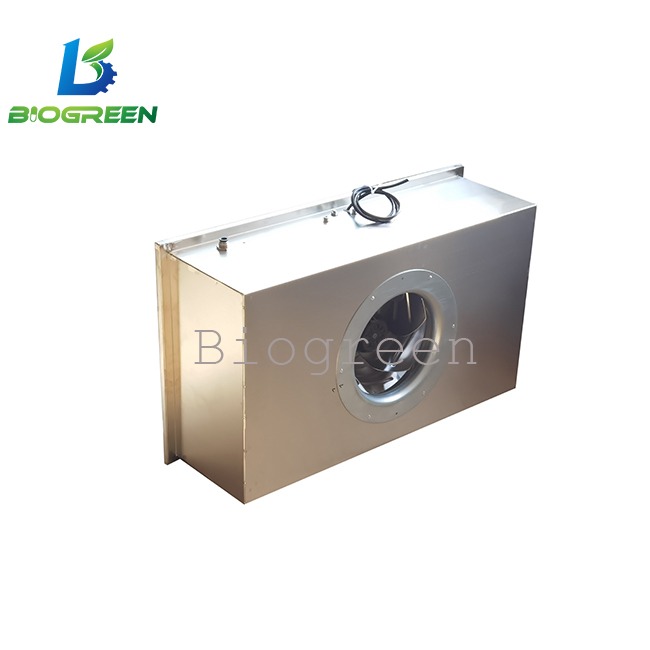
Cost Modeling: FFU + HVAC vs. Fully Ducted Cleanrooms
Fully ducted HVAC cleanrooms require extensive sheet-metal work, individual HEPA housings, volume dampers, and complex balancing. A fan filter unit for clean room hybrid design eliminates most of that ductwork, reducing capital costs by 20–35 % on typical projects. Maintenance also becomes simpler—technicians swap FFU filters from inside the room or above the ceiling without dismantling duct connections.
Operating costs favor the hybrid model as well, especially when variable-speed FFUs respond dynamically to real-time particle counts or occupancy sensors.

Conclusion — Smart Cleanroom Design Leverages Both Systems
Do not choose between central HVAC and distributed FFUs. Choose both. Let the AHU manage conditioning and pressurization while each fan filter unit cleanroom module delivers precision filtration exactly where your process demands it. This FFU HVAC partnership reduces construction cost, saves energy, and gives your facility the flexibility to adapt as requirements evolve. The best cleanroom designs never rely on a single system—they integrate intelligently.
We'll call you
In order to serve you better, if you could kindly send an e-mail to nick@biogreenness.com for questions and details about your theoretical and special architectural plans, projects, and product specifications, your request will be responded to as soon as possible.
We'll call you
In order to serve you better, if you could kindly send an e-mail to nick@biogreenness.com for questions and details.


