
 CALL AN EXPERT! +86-131-3073-8426


Softwall Cleanroom Cost 2026: Price & Sizing Guide
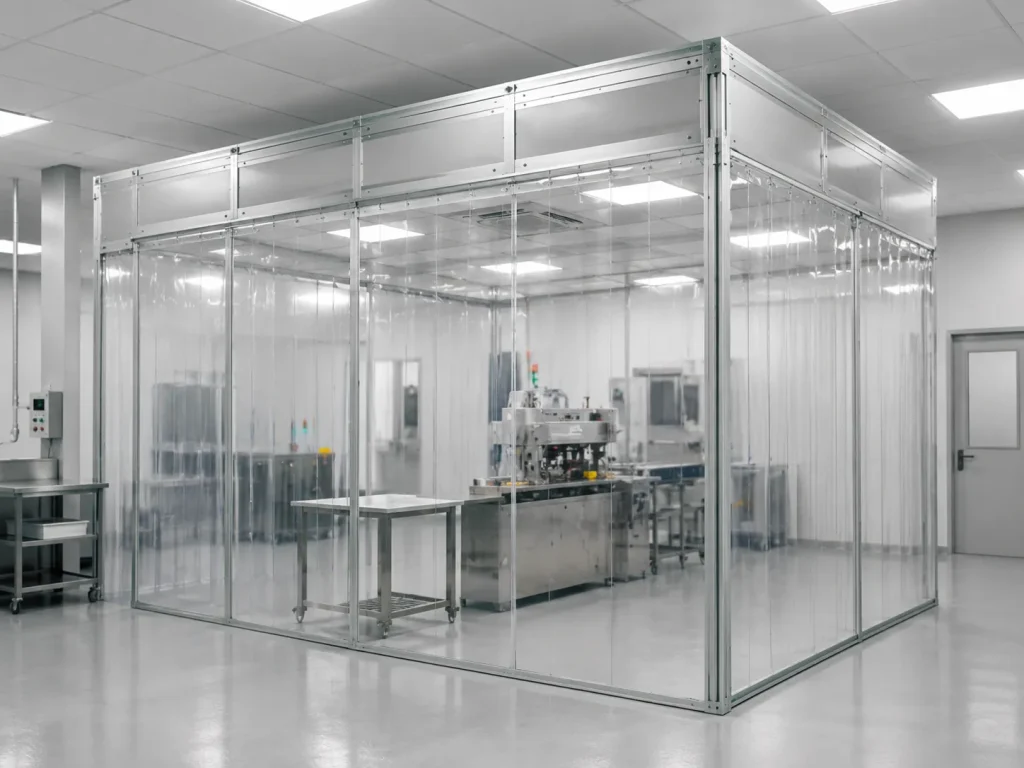
The softwall cleanroom cost in 2026 can range from roughly $7,000 for a small equipment-only enclosure to $30,000+ for a larger basic system, while installed projects with dedicated HVAC, electrical work, environmental controls, and certification can cost substantially more. The biggest pricing mistake is comparing a factory equipment quotation with a turnkey cleanroom proposal. Buyers should define ISO class, dimensions, FFU capacity, environmental controls, and installation scope before comparing bids.
Table of Contents
ToggleHow Much Does a Softwall Cleanroom Cost in 2026?
Typical Budget Ranges by Floor Area and ISO Cleanliness Class
Current US supplier listings provide a useful starting point. One supplier lists an 8 x 8 x 8 ft ISO 8 softwall room at about $8,843 and the ISO 7 version at about $10,240. A 10 x 12 x 8 ft system is listed at approximately $11,409 for ISO 8 and $12,627 for ISO 7.
Another US supplier lists standard ISO 8 systems from approximately $6,897 for 64 ft² to $14,719 for 288 ft². These figures illustrate equipment pricing rather than a universal turnkey benchmark.
Floor Area | Typical Equipment Budget | Typical Application |
64-100 ft² | $7,000-$12,000 | Inspection, small assembly |
120-200 ft² | $10,000-$18,000 | Electronics, medical device |
200-300 ft² | $14,000-$25,000+ | Production cell, packaging |
Turnkey controlled project | $75-$150+/ft² | HVAC, installation and controls included |
A broader cleanroom cost guide places basic softwall construction around $75-$150 per square foot, with specialized HVAC and utilities potentially adding further cost.
Cost per Square Foot vs Cost per Square Meter
For budgeting, $75-$150/ft² is approximately $807-$1,615/m². This conversion helps international procurement teams compare US, European, GCC, and Asian quotations on the same basis.
However, the modular softwall cleanroom cost does not scale perfectly with area. A 100 ft² room still needs controls, FFUs, lighting, framing, electrical connections, and an entrance, so smaller rooms frequently have a higher cost per square foot than larger enclosures.
In our experience, buyers get more reliable comparisons by requesting a line-item quotation showing frame, curtains, FFUs, HEPA filters, lighting, controls, freight, installation, commissioning, and certification separately.

Equipment-Only Price vs Installed Turnkey Project Cost
The softwall clean room price shown online usually represents a preconfigured enclosure. Flow Cleanrooms, for example, states that some systems can be assembled in less than a day, illustrating why modular equipment can have relatively low installation labor.
- Dedicated electrical circuits
- HVAC cooling or heating
- Humidity control
- ESD flooring or ionization
- Fire-alarm coordination
- Particle testing and certification
- Freight, duties, and site installation
Those additions can move a $15,000 equipment package into a $25,000-$50,000+ project, depending on facility conditions.
What Determines the Final Softwall Cleanroom Price?
ISO Class, FFU Quantity, HEPA Coverage and Required Airflow
The biggest technical driver of softwall cleanroom price is usually filtration capacity.
ISO 14644-1:2015 remains current in 2026 and classifies cleanrooms according to airborne particle concentration. It does not prescribe a fixed number of air changes or FFUs for each ISO class.
A typical 2 x 4 ft FFU can supply around 700 CFM; one Terra Universal specification lists approximately 717 CFM, while another commercial FFU is rated at 706 CFM.
Higher cleanliness levels normally require greater HEPA ceiling coverage and airflow capacity. Current pricing illustrates the impact: an 8 x 10 ft ISO 7 system is listed at $10,676 versus $9,356 for ISO 8 – about a 14% difference.
Frame Size, Ceiling Height, PVC Curtain and Entrance Configuration
Standard 8-ft-high rooms cost less than custom 10- or 12-ft structures because taller frames require more structural material and curtain area.
Curtain specifications matter as well. Commercial systems may use approximately 40-mil static-dissipative vinyl, while optional ESD, flame-retardant, opaque, or specialty curtains increase the softwall clean room price.
Entrances should also be coordinated with building codes. For US projects, the 2024 IBC generally requires qualifying egress doors to provide at least 32 inches (813 mm) of clear width.
HVAC, Temperature, Humidity, ESD Control and Electrical Requirements
A softwall enclosure is easiest to justify where particle control is the main objective.
Once a project requires 20-22°C temperature stability, narrow RH control, pressure cascades, chemical filtration, or tightly controlled ESD conditions, the HVAC and controls can cost as much as or more than the enclosure.
From the projects we’ve completed, specification changes made after purchase – particularly humidity control and additional electrical capacity – are usually more expensive than defining them during design.
How to Size and Specify a Softwall Cleanroom Before Requesting Quotes
Calculate Floor Area, Process Footprint and Personnel Working Space
Do not size the room from machine dimensions alone.
If production equipment occupies 120 ft², adding approximately 3-ft working clearances, operator space, carts, maintenance access, and material staging can easily push the practical enclosure requirement above 200 ft².

Estimate FFU Capacity Without Oversizing the Airflow System
Start with room volume:
Airflow (CFM) = Room Volume x Design ACH / 60
A 12 x 20 x 8 ft enclosure contains 1,920 ft³. At an engineering design basis of 60 ACH, theoretical supply airflow would be approximately 1,920 CFM – roughly three 700-CFM FFUs before accounting for leakage, filter loading, process heat, airflow distribution, and qualification results.
Do not treat 60 ACH as an ISO requirement. ISO 14644 specifies particle performance, so final FFU quantities should be based on contamination generation and verification testing rather than an arbitrary ACH rule.
This engineering step can significantly reduce modular softwall cleanroom cost by avoiding unnecessary FFUs and their long-term electrical consumption.
Compare Softwall vs Hardwall Cleanroom Total Cost and Project Risk
Softwall rooms offer lower capital cost, fast installation, and easy relocation. Hardwall systems provide better pressure control, environmental stability, acoustic isolation, and integration with controlled HVAC.
One current cost guide places softwall systems around $75-$150/ft², compared with approximately $150-$250/ft² for modular ISO 7 hardwall rooms.
FAQ
How much does a softwall cleanroom cost per square foot?
A reasonable preliminary US budget is approximately $75-$150/ft² for a basic softwall system, although specialized HVAC, utilities, validation, and controls can push installed costs higher.
Is an ISO Class 7 softwall cleanroom more expensive than ISO Class 8?
Usually, yes. Higher airflow and HEPA coverage commonly increase equipment cost. Current 8 x 10 ft listings show an ISO 7 unit at $10,676 versus $9,356 for ISO 8, although the exact difference varies by manufacturer and performance specification.
When should I choose a hardwall cleanroom instead?
Choose hardwall construction when the process requires tighter pressure control, stable temperature/humidity, secure access, stronger segregation, or more permanent GMP infrastructure. Softwalls are usually better for localized particle control, temporary production, inspection, and applications where flexibility matters.
The final softwall cleanroom cost should therefore be calculated from process area, ISO classification, actual airflow demand, FFU quantity, environmental controls, and installation scope – not from square footage alone. A properly defined RFQ makes it much easier to compare suppliers without mistaking a low equipment quotation for a complete cleanroom project.
We'll call you
In order to serve you better, if you could kindly send an e-mail to nick@biogreenness.com for questions and details about your theoretical and special architectural plans, projects, and product specifications, your request will be responded to as soon as possible.
We'll call you
In order to serve you better, if you could kindly send an e-mail to nick@biogreenness.com for questions and details.


