
 CALL AN EXPERT! +86-131-3073-8426


Cleanroom Fan Filter Units: Selecting the Right CFM for Your ISO Class
Airflow volume sits at the heart of every cleanroom classification. Choosing the right cleanroom fan filter units determines whether your facility meets its target ISO class—or falls short. This guide walks you through CFM calculations, ISO requirements, and practical layout strategies so you can select fan filter units with confidence.
Table of Contents
ToggleUnderstanding CFM and Air Changes Per Hour
CFM stands for cubic feet per minute, measuring how much air a fan filter unit moves. Cleanroom engineers convert CFM into air changes per hour (ACH) to evaluate whether a room flushes contaminants fast enough.
The formula is straightforward:
ACH = (Total CFM × 60) ÷ Room Volume (ft³)
A higher ACH means the room replaces its air more frequently, pushing particle counts down. Every ISO class demands a specific ACH range, making CFM the single most important specification when you select a clean room fan filter unit.

ISO 14644-1 Classes and Minimum Airflow Requirements
ISO 14644-1 defines cleanroom classes from ISO 1 (strictest) to ISO 9 (least strict). Each class requires different airflow velocities and ACH rates:
- ISO 5:240–480 ACH, with unidirectional airflow at 0.36–0.54 m/s
- ISO 6:150–240 ACH
- ISO 7:60–150 ACH
- ISO 8:10–25 ACH
An FFU clean room operating at ISO 5 needs significantly more ceiling coverage than one targeting ISO 7 or ISO 8.
How to Calculate the Number of FFUs You Need
Follow these steps to determine your FFU quantity:
- Calculate room volume:Length × Width × Height (in feet).
- Determine target ACHbased on your ISO class.
- Calculate total CFM required:(Room Volume × ACH) ÷ 60.
- Divide total CFM by single-unit CFM outputto find how many fan filter units you need.
For example, a room measuring 20′ × 20′ × 10′ has a volume of 4,000 ft³. Targeting ISO 7 at 90 ACH, you need 6,000 CFM total. If each unit delivers 600 CFM, you need 10 fan filter units.
Choosing the Right FFU Size: 2’×4′ vs. 4’×4′ Units
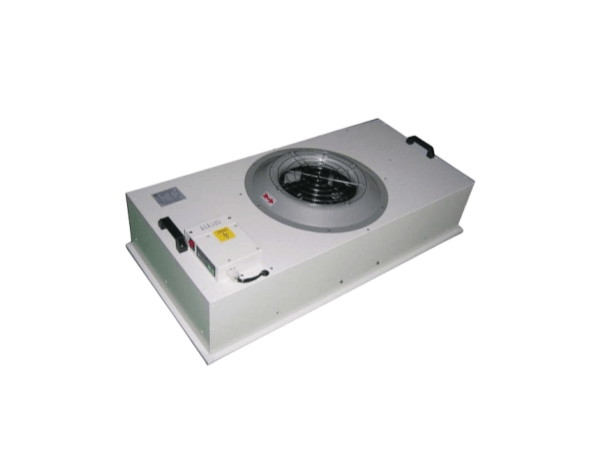
Standard cleanroom fan filter units come in two common footprints:
- 2’×4′ unitstypically deliver 400–700 CFM and fit standard ceiling grid layouts.
- 4’×4′ unitsdeliver 800–1,400 CFM and cover larger areas with fewer individual units.
Selecting the right size depends on your ceiling grid design, required coverage percentage, and maintenance accessibility. Most ISO 5 facilities aim for 80–100% ceiling coverage, while ISO 7 rooms often need only 15–25%.
Oversizing vs. Undersizing: Getting the Calculation Right
Undersizing creates serious problems. Insufficient airflow raises particle counts, risking product contamination and failed classification audits. Oversizing wastes energy and increases operating costs without meaningful cleanliness gains.
Variable speed fan filter units offer a practical solution. These units let operators adjust CFM output to match different operational modes—full production, at-rest, or maintenance. This flexibility reduces energy consumption during low-activity periods while maintaining full capability during critical operations.
Practical Example: FFU Layout for an ISO 5 Cleanroom
Consider an ISO 5 room measuring 12′ × 24′ × 9′:
- Room volume:2,592 ft³
- Target ACH:360
- Total CFM required:(2,592 × 360) ÷ 60 = 15,552 CFM
- Ceiling area:288 ft²
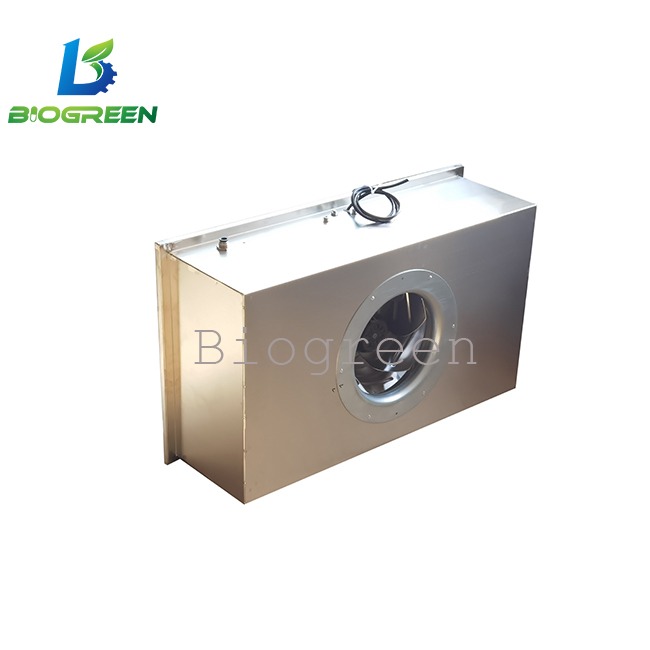
Using 2’×4′ units (8 ft² each, 600 CFM output), you need approximately 26 units to achieve roughly 90% ceiling coverage and deliver adequate airflow. Arranging these units in a uniform grid pattern ensures consistent unidirectional flow across the entire work zone.

Conclusion: The Right CFM Calculation Drives Cleanroom Performance
Selecting the correct clean room fan filter unit starts with accurate CFM calculations tied directly to your ISO class requirements. Measure your room, identify your target ACH, and choose an FFU clean room configuration that delivers the right airflow without excessive energy waste. When you match the right number of fan filter units to your specific application, you build a cleanroom that performs reliably—audit after audit.
We'll call you
In order to serve you better, if you could kindly send an e-mail to nick@biogreenness.com for questions and details about your theoretical and special architectural plans, projects, and product specifications, your request will be responded to as soon as possible.
We'll call you
In order to serve you better, if you could kindly send an e-mail to nick@biogreenness.com for questions and details.


